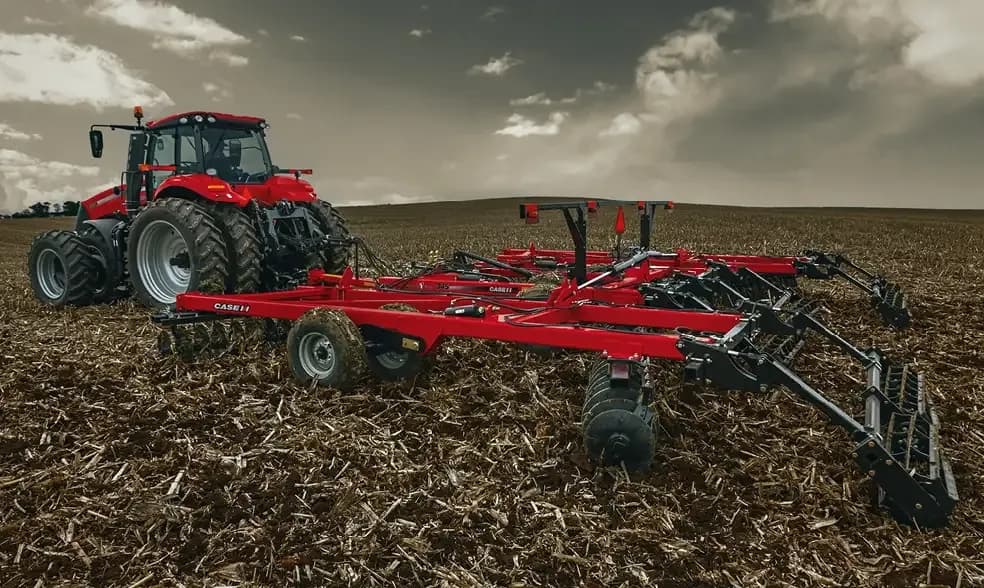
True-Tandem 345 Disk Harrow
Achieve superior soil conditioning with straight, easy pulling and robust design.
The CASE IH True-Tandem™ 345 disk harrows offer straight, easy pulling for primary tillage, seedbed preparation, or chemical incorporation, available in various working widths.

Working Width
22 to 47 ft
HP Required
220 - 485 HP
Blade Spacing
7.5 or 9 in
Blade Strength
30% stronger Earth Metal

True-Tandem Disk Harrow 345 Overview
The True-Tandem™ 345 disk harrows are engineered for efficient and effective primary tillage, seedbed preparation, and chemical incorporation. With a focus on durability and performance, these harrows feature advanced blade technology and a strengthened frame to withstand demanding agricultural conditions. The symmetrical gang angle ensures consistent soil engagement and residue mixing, leading to optimal field results.
- Straight, easy pulling for reduced operator fatigue and efficient operation.
- Durable Earth Metal Disk Blades provide extended lifespan and decreased downtime.
- Uniform pulling pressures and residue mixing due to symmetrical gang angle.
- Increased frame strength for enhanced reliability and longevity.
- Improved soil conditioning with the Active Hydraulic Double-edge Rolling Reel.
Explore True-Tandem 345 Disk Harrow Features
True-Tandem 345 Disk Harrow Specs
Efficient Tillage
- Symmetrical 18-degree gang angle for uniform pulling and residue mixing.
- Available in multiple sizes to match various operational needs.
- Active Hydraulic Double-edge Rolling Reel for superior soil conditioning.
Specifications
General
See the True-Tandem 345 Disk Harrow in Action


Request a Quote
Tell us what you're looking for and a local Sonsray representative will reach out to you promptly with pricing and availability.
- No obligation — just honest answers from equipment experts.
- Fast response from your nearest Sonsray location.
- Factory pricing, financing options, and trade-in evaluation available.
- We carry new, used, and demo equipment across all brands.
Prefer to Talk?